
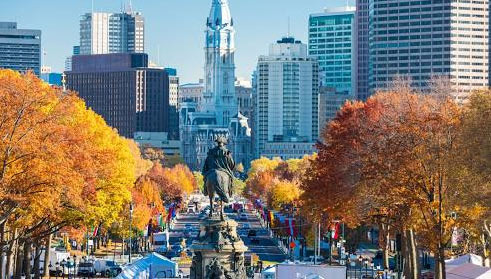
Narrow roads, aging infrastructure, and severe rush hour congestion—it's safe to say it's a 'city where driving makes you age.' Tourists come to see the Liberty Bell, but the reality for residents is living bound by traffic, not liberty.
First, let's talk about the traffic congestion and vehicle overcrowding issues. Philadelphia's road structure is based on a gridded design from the 17th century, which is now more of a hindrance. The streets are narrow, and there are many one-way roads, making vehicle flow less than smooth. When rush hour hits, downtown roads can turn into virtual parking lots.
Particularly notorious are the I-76 Schuylkill Expressway and Vine Street Expressway, which during rush hour resemble a 'moving turtle race.' The problem is that parking in the city is also not easy. Space is limited, parking fees are high, and enforcement of illegal parking is quite strict.
Next is the reality of public transportation. Philadelphia's public transit is managed by SEPTA (Southeastern Pennsylvania Transportation Authority), and while the system is diverse (subway, bus, trolley, commuter train), the issue is 'aging.' Trains are often delayed, buses get stuck in traffic, and outside of rush hours, the intervals between services are too long, making it inconvenient to use. Citizens joke that "sometimes walking is faster than taking the train," but often, it's not just a joke. For this reason, dependence on personal vehicles continues to rise, creating a vicious cycle that leads back to road congestion.
Another significant issue is the lack of infrastructure for bicycles and pedestrians. In recent years, Philadelphia has aimed to be a 'bike-friendly city' by increasing bike lanes, but there is still a long way to go. In many places, a thin painted line is all that separates the bike lane from the road, and collisions between vehicles and bicycles frequently occur at intersections.
This traffic structure ultimately leads to environmental issues. The vehicle-centric city structure results in serious exhaust and fine dust pollution, with high carbon emissions. Philadelphia still lacks electric vehicle charging stations and eco-friendly transportation infrastructure compared to major cities like New York or Seattle. Air pollution from car emissions also affects residents' respiratory health.
Another aspect that cannot be overlooked is the connectivity between the suburbs and the city center. Many residents have expanded into suburban areas, and every day, countless people commute from nearby areas like Montgomery County or Bucks County to the city center. However, the commuter trains and highways are not well connected, leading to traffic paralysis during rush hours. The entrances to the city, such as I-476 or the PA Turnpike, are particularly notorious for being commuting nightmares.
Of course, the city is not sitting idle. SEPTA is working on modernizing its lines and reducing service intervals through the "Reimagining Regional Rail" project to restore trust in public transportation. Additionally, the city of Philadelphia is working on expanding bike lanes and improving pedestrian safety, and in some areas, smart traffic systems are being piloted to automatically adjust signal systems.
However, these improvements are still progressing slowly. Residents continue to waste time on their commutes, and tourists experience confusion due to the unfamiliar traffic system. In fact, Philadelphia's traffic issues are not just about the roads but are complex problems stemming from the city's growth patterns and structural design limitations.
Ultimately, for Philadelphia to overcome its traffic woes, long-term urban planning and technological innovation are needed rather than short-term road expansions. Expanding eco-friendly transportation, enhancing electric vehicle infrastructure, restoring trust in public transit, and designing people-centered streets are likely the answers.


 Northeastern |
 Nationally Certified Lightning Charcoal Review |
 American Grape Shine Muscat |
 sparkling |
 U.S. Weather Bureau News |
  Korean Mom |
  My NYC |
  moo moo |
  Mr Oh |
  forevergee |
  festival |
  manchester |
  constant |
  Leapfrog Move |
  vibranto |
  Tora Tora |
  yellowbutter |
  Dolly |
  US Embassy |
  NYC saladbar |
  Finding Superfoods |
  lightyear |
  song bang |
  vexomo |
  Indiana Jones |