

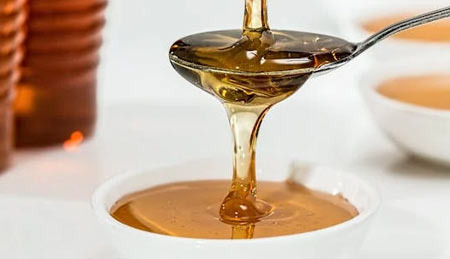
Let's summarize the nutritional value of a spoonful of honey and the states in the U.S. where bees are most active.
Nutritional Components
-
For 1 tablespoon (21 g), the calorie count is 64 kcal, fat 0 g, protein 0.1 g, carbohydrates 17 g (all natural sugars).
-
When converted to 100 g, it has about 304 kcal, 82 g of carbohydrates, and 17 g of moisture. It also contains trace minerals like potassium, calcium, and iron.
-
The unique charm of honey comes from its antioxidant and antibacterial properties, thanks to 'phytochemicals' (flavonoids and phenolic antioxidants) and enzymes (glucose oxidase), which is why honey can help soothe a scratchy throat.
Honey Also Has 'Varieties'
The color, taste, and aroma vary slightly depending on the type of flower, such as acacia, clover, and orange blossom. A deep amber color typically indicates a higher mineral content, while a light golden color is known for its clean taste, according to beekeepers!
Hometown of U.S. Honey Jars
According to the 2024 USDA preliminary statistics and local agricultural news, the rankings are summarized as follows.
-
North Dakota 36.26 million pounds
-
California 13.33 million pounds
-
South Dakota 13.25 million pounds
-
Montana 10.08 million pounds
-
Minnesota 6.85 million pounds
Why is the Northern Great Plains Dominant?
-
Honey flower crops like sunflowers, clover, and canola are widely spread.
-
The short summer allows flowers to bloom all at once, enabling bees to gather nectar in a concentrated period.
-
In winter, they move to the south (California, Texas, Florida) to harvest 'winter honey', making migratory beekeeping common between these regions.
Additionally, Texas, Florida, Idaho, and Oregon are consistently noted as strong states producing over 2 million pounds.
Why Commercial Honey Undergoes "Low-Temperature Heating"
-
Adjusting moisture to below 18.6%
-
Naturally aged honey has varying moisture levels depending on rainfall, bee species, and wax humidity.
-
Moisture is reduced to 17-18% to prevent fermentation (alcohol and bubbles) by osmophilic yeasts. (Methods include hot air dehydration, heating, and vacuum drying.)
-
-
Delaying crystallization
-
Low-temperature heating at 40-50 °C melts glucose crystals, resulting in a clear and easily pourable product.
-
-
Convenience of filtration and sterilization
-
During heating, fragments of honeycomb, yeasts, and spores are filtered out to extend the shelf life.
-
In summary, while '50 °C heating = sterilization' is partially true, the main reason honey does not spoil is more closely related to the process of reducing moisture rather than heat treatment!
Tips for Enjoying Honey Deliciously
-
Remember to add it to warm water below 40 °C or yogurt to preserve its aroma and enzymes.
-
Also, keep in mind that its calories are quite high compared to simple sugars, so it's not necessarily a 'health food over sugar'!
When you need a sweet energy boost, how about a spoonful of natural honey for a pleasant sugar recharge?





 Moscow Kim |
 Seattle - Emerald City |
 self-evaluation |
 Sandiego Auntie |
 Karina's Blog |
 xylora |
 Aura-Infused WACAM |
 wendra |
 There Are Such Things in the World |
 Atlanta Mama |
  Baguette Blog |
  US Embassy |
  Korean Mom |
  My NYC |
  moo moo |
  Mr Oh |
  forevergee |
  festival |
  manchester |
  constant |
  Leapfrog Move |
  vibranto |
  Tora Tora |
  yellowbutter |
  Dolly |
  NYC saladbar |
  Finding Superfoods |
  lightyear |
  song bang |