
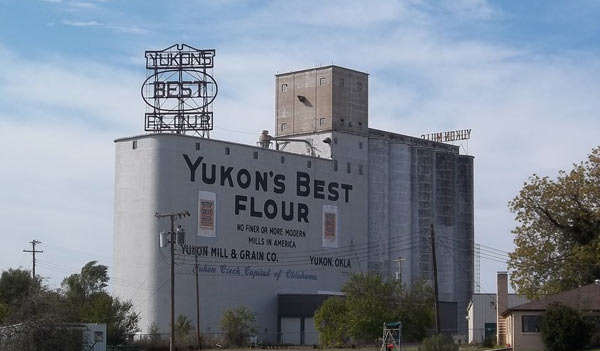
'Yukon's Best Flour Mill' in Yukon, Oklahoma, was once a representative industrial facility of the area.
Although it has now closed and ceased operations, the white concrete silos and red neon sign remain as symbols of Yukon.
The mill's origins date back to the late 1890s. Initially, it was a small grain elevator that stored and processed wheat, but around 1902, it changed its name to 'Yukon Mill and Grain Company' and established a full-fledged milling facility. The business was started by the Crowtil brothers, who immigrated from the Czech Republic. They had both the technology and capital, and by the 1930s, they had grown the company to produce over 2,000 barrels of flour a day.
The brand created at that time was 'Yukon's Best Flour.' The name quickly spread nationwide and became a symbol of the quality of Oklahoma agricultural products. At that time, the Yukon High School sports team was named 'Miller Man,' indicating that the milling industry was part of the local identity.
However, time did not spare this factory either. By the 1970s, the milling industry itself underwent rapid changes. Mechanization progressed, and large mills emerged, causing small and medium-sized factories to lose their footing. Production costs increased while flour prices dropped, making it difficult to maintain operations.
Ultimately, this mill was acquired by another company in the early 1970s and closed shortly thereafter. The last operations are believed to have ceased around 1974. Since then, milling functions have completely stopped, and it was briefly used for storage or cooperative purposes before being left abandoned.
However, the famous sign remains. The sign with the words 'Yukon's Best Flour' that glowed red every night was a source of nostalgia and pride for the local residents. In 2013, it was illuminated again with LED lights funded by citizens' donations. However, in recent years, as the Yukon area has rapidly developed, the site of the mill has gained renewed attention.
Plans have been announced to build a hotel, office, and apartment complex under the name 'Yukon Technology Center,' raising concerns in the community about the potential obscuring or demolition of the old mill building. Residents have launched online petitions stating, "At least the sign should be preserved," and ultimately, this building was listed on Oklahoma's 'Most Endangered Historic Buildings' list.
So why did such a symbolic building close down?
First, the industrial structure changed. In the past, local wheat could be processed and sold directly, but with the establishment of a nationwide logistics network, small mills were pushed out of competition. Second, machinery and equipment became outdated, and there was a lack of investment capacity. Third, ownership changed multiple times, leading to a loss of corporate identity, and ultimately, operations ceased after being absorbed by a large external corporation. Finally, the lack of modernization investments that matched the changing times led to a loss of profitability.
In the end, Yukon's Best Flour Mill fulfilled its role in the flow of time. Although its milling function has disappeared, the massive white silos and red-lettered sign still stand out when passing through the city.





 daisypat |
 hazelnut |
 rustley |
  Chimhanbang Korea ACU |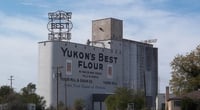
 Tonky |
  viroma |
  cookie |
  Live and that's it |
  Alright Twain |
  eatontown blog |
  HAWAII Korean Church News |
  Amore |
  linex |
  Balancework |
  laro90 |
  MEDBIO American Doctor Blog |
  SWAT TEAM BLK |
  DREAM BIG |
  frostbite |
  330 Forever My Love |
  El Dorado |
  dralix58 |
  Gorama Round |
  Skydiving |