

Today, I was standing by my window watching the sunset. I was just staring blankly when suddenly this thought crossed my mind.
If I take a plane and fly west following the sun, theoretically, wouldn't the sun keep shining?
It's a rather pointless thought, but it connects to questions about Earth science. So, I took out my calculator and did some calculations.
My major is statistics, so I know quite a bit about mathematical formulas.
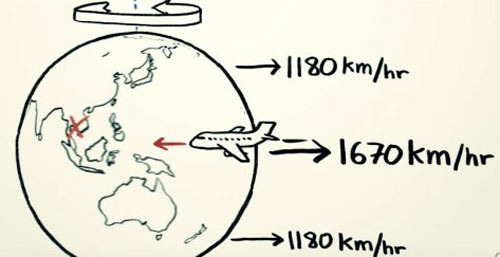
The reason we experience night every day is that the Earth is diligently rotating eastward once every 24 hours.
So, to prevent the sun from setting, I would need to fly west at the same speed that the Earth is rotating.
It's exactly like running forward on a treadmill to avoid being pushed back.
The circumference of the Earth is about 40,075 km, and since it makes one complete rotation in 24 hours, the rotational speed at the equator is about 1,670 km/h.
This speed decreases as you move away from the equator. So, at the equator, it's 1,670 km/h, around 1,385 km/h near latitude 34 degrees like in LA, and about 1,330 km/h in Seoul.
The latitude of Fair Lawn is approximately 40.85 degrees north. The Earth rotates at about 1,670 km/h at the equator, but this speed decreases by the cosine value as you move north. If you calculate this, it becomes 1,670 × cos(40.85°), which results in about 1,260 km/h. So, even though we feel like we are standing still in Fair Lawn right now, we are actually flying eastward at about 1,260 km/h along with the Earth.
The cruising speed of common aircraft like the Boeing 737 or 747 is around 850 to 900 km/h, so no matter how much you fly west on a passenger plane, the sun will eventually set.
At the equator, you would need to fly faster than the speed of sound, so it's practically impossible unless you're in a fighter jet or a special aircraft.
Considering realistically possible aircraft, all civilian planes were out of the question. The only one that was feasible in civilian aviation was the Concorde, and among fighter jets, models like the F-15 or F-22 could do it. The ultimate champion was NASA's SR-71 Blackbird. This aircraft could fly over 3,500 km/h, not just catching up to the sun but actually making it rise from the west.
And there was one important point. The direction had to be perfectly west. If it deviated even slightly to the north or south, it wouldn't completely offset the Earth's rotational speed, and night would eventually come. The speed of this flight was as crucial as the angle.
It was a bit funny to think about this while watching the sunset in Fair Lawn, but realistically, to avoid night forever, you would have to rent a fighter jet or move to the North Pole.
In the end, we feel like we are living the same day over and over, but in reality, we are spinning through space at speeds exceeding 1,000 kilometers per hour. Even in that moment of standing still and staring at the sunset in Fair Lawn, the Earth was continuously rotating, and we were on it, traveling. Sometimes, looking up at the sky and pondering these thoughts seems to make the day a little more special.
Tonight, the Earth will continue to spin quickly while orbiting the sun, and tomorrow the sun will rise again.






 candytip |
 Gold Bar |
 Pirate Ship Popcorn Maker |
 Montgomery Mom |
 Anjollinya Blog |
 squidogame |
 Margarine Daebimama |
 eatontown blog |
 cloudyday |
 Google Idea |
  Korean Mom |
  My NYC |
  moo moo |
  Mr Oh |
  forevergee |
  festival |
  manchester |
  constant |
  Leapfrog Move |
  vibranto |
  Tora Tora |
  yellowbutter |
  Dolly |
  US Embassy |
  NYC saladbar |
  Finding Superfoods |
  lightyear |
  song bang |
  vexomo |
  Indiana Jones |