
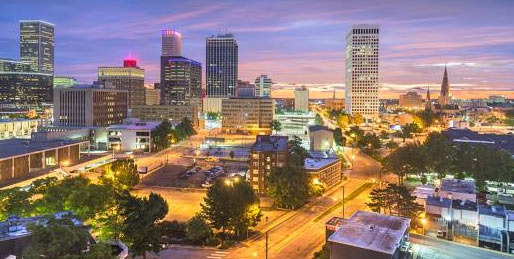
The words 'Okla' and 'Homa' mean 'red people' in the Choctaw Native American language.
Thus, the name 'Oklahoma' itself symbolizes the indigenous people.
Oklahoma has long been the homeland of Native Americans. It was inhabited by tribes such as the Choctaw, Cherokee, Chickasaw, Creek, and Seminole. These five tribes were referred to in English as the 'Five Civilized Tribes,' as they entered into treaties with the U.S. government and adopted Western-style agriculture, schools, and legal systems.
However, in the 1830s, the situation changed dramatically with the introduction of the 'Indian Removal Act.' The U.S. government forcibly expelled Native Americans from the eastern regions and relocated them to what is now Oklahoma. The journey was so treacherous that thousands died from disease and cold, and this painful journey is still referred to as the 'Trail of Tears.'
After that, this area was called the 'Indian Territory.' It was literally land for Native Americans. However, in 1889, the U.S. government opened part of this land to white settlers, changing the situation again. This was the famous 'Oklahoma Land Rush.' Tens of thousands of people raced on horseback to claim land. In just a few hours, many people settled, and the land where Native Americans lived gradually diminished.
As cities emerged and the population grew, Oklahoma was admitted as the 46th state of the United States in 1907. At this time, the Indian Territory and Oklahoma Territory were merged. Then, in the early 20th century, the discovery of oil completely transformed the region. Oil became so valuable that it was referred to as 'Black Gold,' and the city of Tulsa once thrived to the point of being called the center of the global oil industry.
However, behind this prosperity was a tragic history. In 1921, Tulsa witnessed one of the most horrific racial violence in American history. The Greenwood area, where many African Americans lived, was attacked by white mobs, burned, and hundreds died. Greenwood was originally known as 'Black Wall Street' for being a center of African American economic activity, but it vanished overnight.
Today, Oklahoma is a state where various ethnicities coexist. Whites make up about 66% of the population, with more than half being non-Hispanic whites. Hispanics or Latinos account for about 12%, African Americans 8%, and Asians about 2%. Notably, there is a significant population of Vietnamese and Filipino descent.
One of the most distinctive features of this state is its large Native American population. About 9% of the total population is Native American, which is much higher than the national average. Currently, 39 tribes in Oklahoma are officially recognized by the U.S. government, and each tribe has its own autonomous rights. Therefore, traditional Native American festivals, arts, languages, and clothing can be easily seen throughout Oklahoma.
In this way, Oklahoma is a state with a unique character in the United States. It embodies the painful history of Native Americans, the settlement of white pioneers, the wealth generated from oil, and the culture created by diverse ethnicities.
Thus, Oklahoma is not just a state on a map, but a small history book that illustrates how the nation of America was formed.




 daisypat |
 Chimhanbang Korea ACU |
 Trustworthy Faces |
 US Regional Information Blog |
  Anytime Journey |
  Mrs. Duluth |
  jaxter |
  Atlanta Mama |
  Baguette Blog |
  US Embassy |
  Korean Mom |
  My NYC |
  moo moo |
  Mr Oh |
  forevergee |
  festival |
  manchester |
  constant |
  Leapfrog Move |
  vibranto |
  Tora Tora |
  yellowbutter |
  Dolly |
  NYC saladbar |