

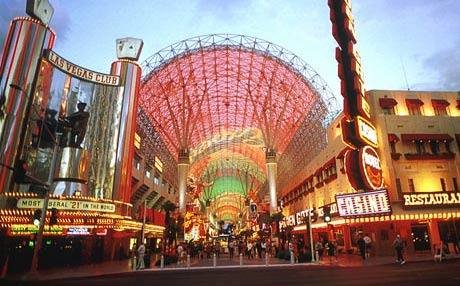
Las Vegas began to establish itself as a casino city when El Rancho Vegas opened in 1941, becoming the first on the Strip.
Over the past 80 years, this city has grown around its casinos and is now the largest gambling hub in the world.
There are more than 30 casino resorts on the Las Vegas Strip alone.
Among them, MGM Grand, Bellagio, Caesars Palace, The Venetian Resort, Wynn, and Encore are notable landmarks.
While Bellagio is famous for its fountain show, inside is the legendary "Bobby's Room" known in the poker world.
This is where the world's top poker players compete for millions of dollars.
Wynn and Encore have a distinctly different atmosphere due to their design that allows natural light to flood in.
Many describe it as feeling like sitting in a garden rather than a gloomy basement, and both resorts maintain a luxurious ambiance while housing over 1,800 slot machines and covering 110,000 square feet of casino space.
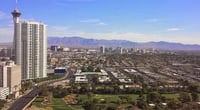
At the northern end of the Strip is the Stratosphere, and heading south, you encounter Luxor and Mandalay Bay, each attracting tourists for decades with their unique concepts.
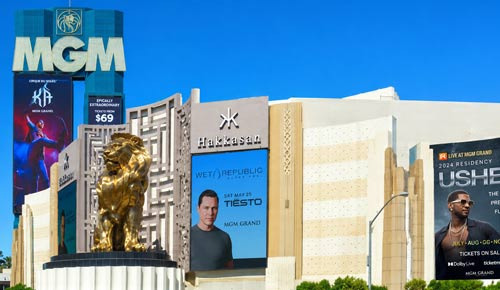
MGM Grand boasts a casino area of about 144,000 square feet, operating 1,234 slot machines and 105 gaming tables.
Since its opening in 1993, it has held the title of the largest resort in the world and continues to dominate in size.
However, the issues faced by the Korean community in this casino city are somewhat complex.
In Nevada, there are at least 20,000 to 30,000 Korean Americans, many of whom reside in Las Vegas.
The Korean population in Henderson makes up 5.61% of the total population, while in downtown Las Vegas, it is about 5.08%. A 5% Korean population is considered high in the U.S.
As Korean shops, restaurants, cafes, and H Mart continue to emerge, the living infrastructure is expanding.
Las Vegas and Ansan, South Korea, have maintained a sister city relationship for over 30 years, and direct flights from Incheon are also in operation.
However, due to the nature of the casino city, the economic structure is heavily skewed towards tourism and service industries, making it feel like there are fewer options for Koreans seeking professional or technical jobs compared to other cities.
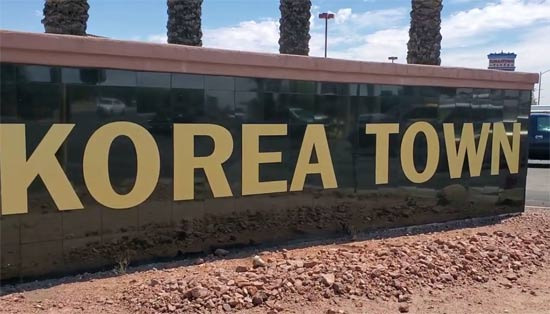
Additionally, the Korean economy in Las Vegas is highly dependent on the tourism industry, making it directly affected by economic fluctuations.
When the number of young tourists from the U.S. and Canada decreases, the first places to feel the impact are Korean restaurants and retail businesses.
Particularly, businesses relying on the Strip and nearby areas often struggle to cope with declining sales and rising rent burdens.
Moreover, the decrease in tourists leads to not just a drop in sales but also a reduction in employment. Given the high proportion of Korean employees in the service industry, job losses are felt quickly.
Ultimately, the contraction in consumer spending spreads throughout the local Korean business community, putting more pressure on the economy, which is primarily based on small businesses.
The Korean American Association of Las Vegas and the Korean American Chamber of Commerce Nevada continue to support collaboration and business within the community, but creating an independent Korean economic ecosystem that is not absorbed by the casino economy remains a challenge.
Behind the glamour created by the casinos, the stories of Koreans who have made this city their home are as diverse and complex as the lights of the Strip.
From Korean dealers to small business owners running Korean restaurants, and 1.5 generation individuals seeking to transition into the IT industry, the Korean community in Las Vegas is still finding its own path forward.
 SojuBoy
 AnaMom
 YallaElle
 KimchiBotUnit

 Smile Face |
 Helpful Life Stories |
 Casa Mia |
 Study Abroad Life Know-How Tips |
 pravix22 |
 vegas mom |
 Anova US Beauty Information |
 US Legal Consultation on Trials |
 celion78 |
  beerdreamer |
  Kims Spring |
  White bunny |
  Kansas City Representative Singer |
  shadow 007 |
  sun walker |
  Choco Choco Star |
  midnight blue |
  honeypot |
  summer |
  adventure77 |
  flexible |
  Shintongbangtong Shin Naerin James Park |
  truepixel |
  Kathy's Blog |
  Hae Naem |
  quatspace |
  Marisol |
  Glassroom |
  Granola |