
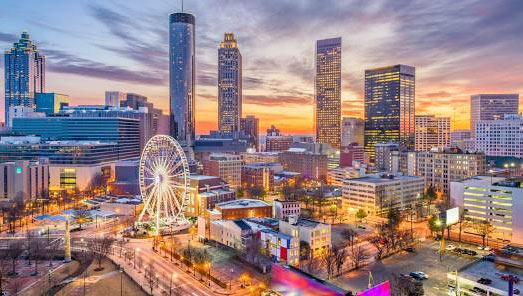
Atlanta was land inhabited by the Native American tribes, the Cherokee and Seminole, but began to change gradually with the arrival of white settlers following the British colonization of Virginia. From the 1820s, white pioneers started to settle in the area, and by 1835, the U.S. military subdued the Seminole and Cherokee tribes, forcing the natives to relocate and allowing white settlers to take over the land.
Subsequently, cotton agriculture became the main industry, leading to the development of railroads for transporting the cotton that was cultivated and harvested in Atlanta, significantly boosting commerce. During this time, black individuals from West Africa were brought to work on cotton plantations through British slave traders, and Atlanta became a society centered around slavery. The famous novel 'Gone with the Wind,' set against this backdrop, depicts the landscapes of the South during that era, particularly featuring Tara Plantation, which is described as being located not far from Jonesboro, near Atlanta.
However, with the outbreak of the Civil War in 1861, Atlanta became a major stronghold for the Confederacy, and much of the city was burned down due to General William Tecumseh Sherman's scorched earth strategy. General Sherman destroyed Southern infrastructure, leading to a loss of morale in the South, which ultimately had to surrender. Reconstruction began after the war, and Atlanta was designated as the capital of Georgia in 1868.
Industrial Development and Reconstruction
Industrial development reached a significant turning point during World War II. In particular, the establishment of an aircraft assembly plant in Marietta led to an industrial revival in the Atlanta area. Additionally, in the 1960s, the civil rights movement, led by Dr. Martin Luther King Jr., gained momentum, making Atlanta a central hub for the movement. Dr. King's influence was profound, and despite his death, the rights of black individuals significantly improved. As a result, in 1973, Atlanta became one of the first major cities in the U.S. to elect a black mayor. Maynard Jackson was elected as that mayor, marking the beginning of a significant change in the city with a black mayor leading it.
Urban Development and Modernization
Entering the 1990s, Atlanta hosted the Summer Olympics in 1996, which led to improvements in the city's aesthetics and urban redevelopment efforts, such as the elimination of ghettos. This made downtown safer, although impoverished areas still exist, and rapid suburban expansion occurred. Today, Metro Atlanta is the ninth largest city in the U.S., with a population of 5.5 million. Its size spans a diameter of 100 km, and the suburban areas have expanded significantly.








 Lululala |
 BOL SA RAM |
 Gook Rule |
 Dragon Lee |
 Blondee |
  Tonky |
  viroma |
  cookie |
  Live and that's it |
  Alright Twain |
  eatontown blog |
  HAWAII Korean Church News |
  Amore |
  linex |
  Balancework |
  laro90 |
  MEDBIO American Doctor Blog |
  SWAT TEAM BLK |
  DREAM BIG |
  frostbite |
  330 Forever My Love |
  El Dorado |
  dralix58 |
  Gorama Round |
  Skydiving |