

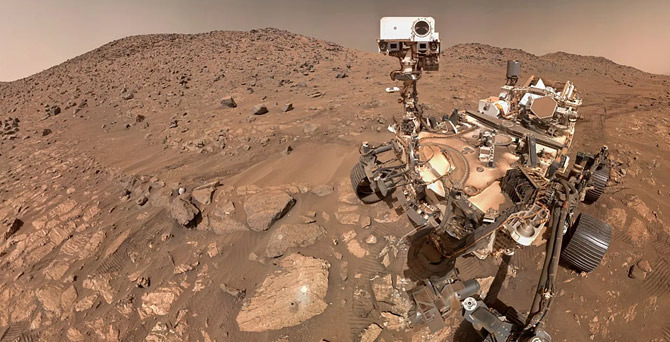
A few days ago, I was watching the news at home, and NASA made quite an interesting announcement.
The Mars rover Perseverance tested rock samples it collected, and the results are said to be unusual.
The components detected in the rocks were similar to those found in Earth rocks that preserve traces of microorganisms.
Moreover, a combination of chemicals that ancient microorganisms might have used was also confirmed in the results.
NASA emphasized that this could be the closest signal to life that has been found so far.
However, at the same time, NASA was cautious.
This discovery is merely a 'potential sign of life,' and it cannot be confirmed until the samples are brought back to Earth for more precise verification.
In short, the key point is that they plan to carry out a project to bring samples from Mars to Earth.
Thinking about it, discussions about organic materials and signs of life on Mars are not new.
During the Viking missions in the 1970s, soil experiment results were quite similar to those from soil samples taken in California, Alaska, and Antarctica.
The data at that time was said to resemble microbial reactions.
However, the researchers soon concluded, "This is not life; it could be results caused by oxidizing substances in the soil."
They effectively ruled out the possibility of life. Yet, subsequent revalidation studies indicated that the 'oxidant' that could explain all the experimental results from that time has still not been found.
There are even criticisms that the most important metabolic experiments at that time were not conducted properly.
So, whether that conclusion was entirely correct remains a topic of debate.
This recent NASA announcement can be understood in that context.
"It is not conclusive evidence, but it is a signal that cannot be ignored," they say.
The media has already sensationalized it with titles like "Life Discovered on Mars?" but, in reality, scientists are calmly taking a step back to observe.
Still, it is impressive that NASA has promoted this quite extensively this time.
It seemed as if they were trying to assert, "We are still at the center of Mars research."
Honestly, these days, Elon Musk's SpaceX is directly challenging Mars with Starship.
Musk is openly talking about building a colony on Mars, and exploration led by private capital has already begun.
In this situation, NASA likely felt the need to convey the message, "We are still leading the way."
Perhaps this announcement holds significant strategic meaning as well as scientific significance.
Ultimately, the important thing is that it is not yet conclusive evidence like a 'fossil.' However, it is hard to deny that the possibility of finding signs of life is increasing more than ever.
Did life really exist on Mars? This question remains open, and it is fascinating to think that our generation might hear the answer directly.
Even on an ordinary day, when I come across such news, I think about the possibility that Mars could have been a place where beings capable of communicating with us once lived.







 Nationally Certified Lightning Charcoal Review |
 Northeastern |
 sparkling |
 Pennsylvania Information News |
 U.S. Weather Bureau News |
  Tonky |
  viroma |
  cookie |
  Live and that's it |
  Alright Twain |
  eatontown blog |
  HAWAII Korean Church News |
  Amore |
  linex |
  Balancework |
  laro90 |
  MEDBIO American Doctor Blog |
  SWAT TEAM BLK |
  DREAM BIG |
  frostbite |
  330 Forever My Love |
  El Dorado |
  dralix58 |
  Gorama Round |
  Skydiving |