

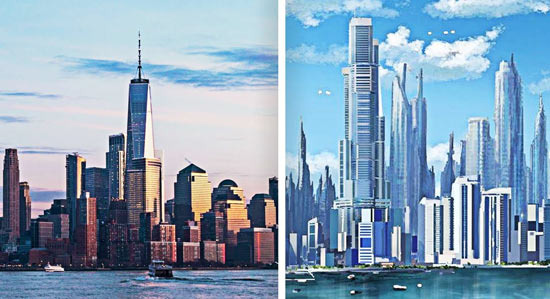
As we approach the end of 2025, looking at the world, it feels like technology is leading us toward a dystopia.
In the early 2000s, we dreamed of a future where "by 2050, cars would be flying!" but now the reality is a world where we spend more time looking at our smartphone screens than at the sky.
Still, some elements of fantasy have become reality. Drone technology has already conquered the skies, and 'flying cars' are in test flights. Currently, the limit is a 30-minute flight, but by around 2050, we might see an era where flights of at least 4 hours become possible.
The problem lies in the direction of technology. As artificial intelligence advances, humans are becoming not the masters but 'feedback providers.' Right now, we command, "AI, play a song," but soon AI might say, "You're not in the mood for that song today," managing even human emotions.
For the sake of convenience, we relinquish our ability to think for ourselves and increasingly live lives tailored to machines. It may become a time when technology controls humans rather than humans controlling technology.
Medical technology will extend human lifespan. Gene editing will become commonplace, and everyone might carry at least one artificial organ. But will living longer guarantee happiness? Even if we live to 120, without money, we will struggle with medical bills and ultimately tire before our lifespan ends. The rich will 'purchase' health, while the poor will 'endure' illness. It's only a matter of time before 'immortal technology' becomes 'expensive survival rights.'
Homes will become smarter. Smart homes that automatically adjust lighting, temperature, and scent will become the norm, but at some point, our homes will know us better than we know ourselves. Refrigerators will remember what we eat, beds will analyze sleep data, and speakers will predict our emotional states. On the surface, it seems convenient, but ultimately, it's a life lived under constant surveillance. The fact that we come to call that 'convenience' is the most frightening part.
The nature of work will also change completely. Instead of commuting, there will be 'project participation,' and instead of companies, there will be 'virtual offices.' It may seem free on the surface, but in reality, it's a life of perpetual instability as a freelancer. Stable jobs will disappear, and one must constantly engage in self-promotion to survive.
As AI takes over tasks, humans are told they must engage in 'creative work,' but the problem is that AI is catching up with that creativity too. Ultimately, we may spend our lives in anxiety trying to find "human tasks that AI cannot do." Even if a basic income system is implemented, will people really maintain their motivation to work?
The world of 2050 may be technologically perfect, but people will become lonelier. Our conversation partners will be chatbots, and comfort will come from robotic pets or surrogate partners. The warmth of real humans will gradually disappear, and ultimately, people will long for someone to hold their hand instead of a smartphone.
In the end, there is one lingering question: "Is this truly living well?" In a world dominated by innovation, efficiency, and data, the one thing we must not forget is that no matter how much the world changes, humans must ultimately live as humans.
But will humanity in 2050 still remember that? That is the most frightening thought.
 USAToday







 xylora |
 Aura-Infused WACAM |
 wendra |
 There Are Such Things in the World |
 US Embassy |
  Korean Mom |
  My NYC |
  moo moo |
  Mr Oh |
  forevergee |
  festival |
  manchester |
  constant |
  Leapfrog Move |
  vibranto |
  Tora Tora |
  yellowbutter |
  Dolly |
  NYC saladbar |
  Finding Superfoods |
  lightyear |
  song bang |
  vexomo |
  Indiana Jones |