
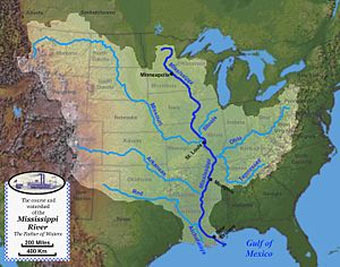
The Mississippi River is one of the most important and famous rivers in North America, deeply connected to the history, economy, and ecology of the United States.
Length: approximately 3,730 km (about 6,275 km from the confluence with the Missouri River, ranking 4th in the world).
Watershed area: approximately 2.98 million km² (including parts of 31 states in the continental U.S. and 2 provinces in Canada).
Source: Lake Itasca in Minnesota.
Delta: Gulf of Mexico (southern Louisiana).
Main tributaries: Missouri River, Ohio River, Arkansas River, Red River, etc.
Historical Significance
Indigenous cultures: For centuries, numerous Native American tribes (such as the Choctaw and Ojibwe) have survived and traded around the river.
European exploration: In 1541, Hernando de Soto of Spain was the first to explore it, and in the 17th century, France began serious development by establishing the "Louisiana" colony.
19th-century trade hub: Utilized as a transportation route for agricultural products and timber during the steamboat era (1807~), driving economic growth in the Midwest.
Civil War: A strategic stronghold fiercely contested by Union and Confederate forces.
Biodiversity: Home to over 360 species of fish and hundreds of species of birds and mammals.
Delta region: The Mississippi River Delta in Louisiana connects wetlands to the marine ecosystem, but experiences soil erosion equivalent to 1,000 football fields each year.
Environmental crisis:
Pollution: Water quality deterioration due to agricultural fertilizers and industrial waste.
Dead Zone: An area of low oxygen forms at the mouth of the Gulf of Mexico, leading to marine life die-offs.
Flooding: Increased risk of heavy rainfall and levee failures due to climate change.
Human-River Symbiosis
Levees and dams: After the Great Flood of 1927, the U.S. Army Corps of Engineers constructed over 3,500 km of levees and 29 dams.
Bridges: Iconic structures such as the Gateway Arch in St. Louis and the Hub Bridge in New Orleans.
Cultural symbols: Inspired works like Mark Twain's "Adventures of Huckleberry Finn," blues music, and Southern literature.
Current Issues
Impact of climate change: Rising sea levels accelerate flooding of the delta.
Civil engineering projects: Efforts to restore wetlands as part of the Mississippi River Delta restoration plan.
Indigenous rights: Ongoing issues of encroachment on traditional territories due to river development.
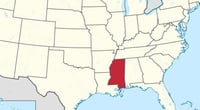
As a central part of the American South, the state is highlighted for its historical ties to the Confederacy, often associated with symbols of the Confederacy, and is perceived through the lens of racial conflict and conservative social structures.
It is often emphasized that the state ranks low in national statistics in areas such as economy and education, leading to stereotypes of being the "poorest state" or "state with poor education." The warm and friendly residents, traditional family values, and simple lifestyle are characteristic. However, this is sometimes mixed with a negative view of being overly conservative.
As the birthplace of Delta blues, it is noted for its musical heritage, producing legendary musicians like B.B. King and Muddy Waters. This cultural richness is often contrasted with economic difficulties.
Known as a representative state of the Bible Belt, recognized for its strong religious influence and Christian fundamentalism, it is often at the center of controversies over conservative policies such as opposition to abortion and restrictions on LGBTQ+ rights.






 frostingline |
 Certified Authentication Blog Page |
 Good World Good Thoughts |
 Lansinger |
  Deep South Mississippi |
  Tonky |
  viroma |
  cookie |
  Live and that's it |
  Alright Twain |
  eatontown blog |
  HAWAII Korean Church News |
  Amore |
  linex |
  Balancework |
  laro90 |
  MEDBIO American Doctor Blog |
  SWAT TEAM BLK |
  DREAM BIG |
  frostbite |
  330 Forever My Love |
  El Dorado |
  dralix58 |
  Gorama Round |
  Skydiving |