

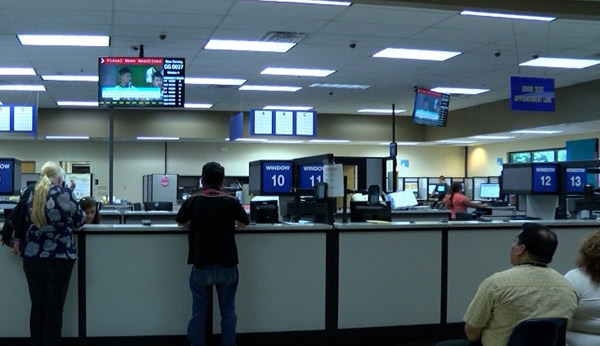
One of the things I constantly encounter while living in California is the DMV.
Living in the U.S., whether it's for a driver's license test, vehicle registration, or address change, you will eventually have to go to the DMV.
However, what's strange is that even though there is an online reservation system and a mobile app, when you actually go there, things are not at all as fast as in Korea, where everything is done quickly. Even with a reservation, waiting in line is a given, and since each staff member has a different way of handling things, you might go in with the same issue and have it resolved one day, while another day you are sent back because they say you are missing a document.
If it were in Korea, the computerized system would be connected, and just entering your resident number would pull up all your past records.
But the DMV still relies heavily on paper. Even if you apply online, the confirmation is printed on paper, and sometimes it takes a long time to arrive by mail. Moreover, sometimes staff make mistakes in data entry, leading to errors in records, and correcting those requires multiple visits.
I actually had a situation where my vehicle registration sticker was sent to the wrong address, and I felt anxious driving for two months. Although the DMV staff said, "Oh, I'm sorry. I'll send it again," it still wasted my time and caused me stress.
What's more frustrating is that this inconvenience is not just a one-time issue. From online reviews and conversations with people around me, I've heard that the California DMV has been known for its inefficiency for a long time.
Even though the reservation system was introduced a few years ago, people still consider waiting for hours to be normal.
Since there isn't a strong push for "let's improve efficiency" like in Korea, it seems that people have just accepted the slow pace as part of the culture. In fact, since DMV employees have a status similar to civil servants, they don't have to worry about being fired, and there is less pressure for performance, so there is no real reason for them to speed up their work.
Sometimes I think, 'Ah, this really is a secure job.' Of course, from their perspective, it is a stable job with good pension and benefits, so it makes sense for them to stick around for a long time.
However, from the user's perspective, they constantly face inefficiency, leading to accumulated dissatisfaction. From the perspective of the public, the DMV seems to lack the will to change. They advertise improvements to the online system, but in reality, they still rely on paper, and staff training is often inadequate, leading to different answers at different counters, and customer complaints are repetitive.
As a 30-year-old, I see little chance of the DMV changing anytime soon. If this is the situation in a populous place like California with high administrative demand, it will be hard to expect a "quick DMV" in the future.
So, when people have to go to the DMV, they mentally prepare in advance. They resolve to dedicate the day to the DMV.
There is a reason why the DMV is called a secure job. Even if systemic improvements are possible, I believe fundamental changes are difficult unless the internal culture and the mindset of the employees change.
Ultimately, the DMV symbolizes the inconveniences of daily life in California.
It is slow and inefficient, but it is an essential place. For someone like me in my 30s, the DMV remains both a "secure job with guaranteed retirement" and an "inevitable rite of passage for the public."
Will there ever be a DMV that operates as quickly as in Korea?



 Toaster Pizza Magic Show |
 Baguette Blog |
 Total Beauty |
 Pirate Ship Popcorn Maker |
 ROLDU WAY |
  Tonky |
  viroma |
  cookie |
  Live and that's it |
  Alright Twain |
  eatontown blog |
  HAWAII Korean Church News |
  Amore |
  linex |
  Balancework |
  laro90 |
  MEDBIO American Doctor Blog |
  SWAT TEAM BLK |
  DREAM BIG |
  frostbite |
  330 Forever My Love |
  El Dorado |
  dralix58 |
  Gorama Round |
  Skydiving |