
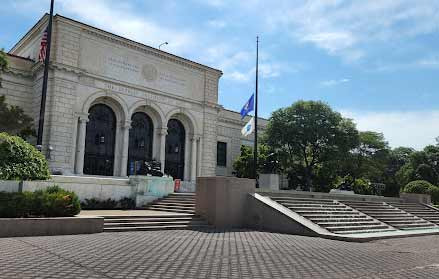
Michigan is the heart of the Midwest and a key state in the Great Lakes region, having grown based on the automotive industry.
However, recently, as the industrial structure diversifies into education, healthcare, technology, and tourism, each city is becoming more distinct.
Let's discuss the industrial characteristics and atmosphere of the top 5 cities in Michigan by population.
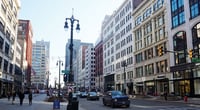
First is Detroit.
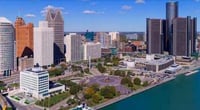
With a population of about 639,000, it is the largest city in Michigan and can be considered a symbol of the American automotive industry, living up to its nickname as 'Motor City.' Major global automotive companies like Ford, General Motors, and Stellantis have their headquarters in this area. Although the city once declined due to industrial stagnation and crime issues, recent downtown redevelopment has attracted startups and artists. In particular, 'TechTown Detroit' is emerging as a hub for new businesses, and the healthcare industry is also growing. It is becoming a symbol of a city undergoing transformation, replacing its former dark image.
The second city is Grand Rapids.
With a population of about 198,000, it is the central city of western Michigan. Known as 'Furniture City,' it has a well-developed furniture manufacturing industry, and recently, it has expanded into medical equipment and healthcare. Large hospitals, including Corewell Health (formerly Spectrum Health), are leading the local economy. It is also famous as a city of arts and culture, with the annual international art competition 'ArtPrize' attracting artists from around the world. During this time, the city is filled with art, making it a popular destination for travelers. Grand Rapids can be described as a city where traditional industry, culture, and tourism blend well together.
The third city is Warren, with a population of about 139,000, located north of Detroit and serving as an industrial hub. The GM Technical Center and military research facilities make the automotive and defense industries the economic backbone. Although it has a typical industrial city image, recent increases in high-tech research institutes and automation-related companies are gradually advancing the industrial structure. Its proximity to Detroit makes commuting convenient, and the lower cost of living is also an advantage, attracting many young engineers.
The fourth city, Sterling Heights, has a population of about 134,000 and is a rapidly growing suburban city. It hosts a large automotive assembly plant of Stellantis, and the defense industry and retail are also growing together. It is a city where various ethnicities coexist, particularly with a significant Arab and Asian population. With diverse cultures, restaurants and shops are very varied, earning it the nickname 'a small world within Michigan.' The clean living environment and stable security make it a preferred area for family migrants.
Finally, Ann Arbor has a population of about 121,000 and is a college town home to the University of Michigan. It is a center for education, research, and technological innovation, showing remarkable growth in the fields of life sciences, AI, and medical technology. The university hospital ranks among the top in the nation, providing excellent medical infrastructure, and startups and research institutes centered around the university play a key role in the city's economy.
Additionally, the state capital, Lansing, has a population of about 113,000, with government agencies and the insurance industry as the main industries. Flint was once the center of automobile production, but its population has decreased to around 80,000 after factory closures. However, there has been a recent revival centered on electric vehicle batteries and recycling industries.
The industrial landscape of Michigan still has its roots in automotive manufacturing, but the direction of industries is changing in each city. Detroit, Warren, and Sterling Heights represent the traditional manufacturing base centered on automotive and defense industries, while Grand Rapids and Ann Arbor represent innovative industries focused on technology, healthcare, and education.
If you are considering retirement, cities like Ann Arbor or Grand Rapids, where healthcare and culture are harmonized, would be suitable, while suburban cities like Sterling Heights or Traverse City would be recommended for those seeking a quieter environment with lower living costs.



 tracker |

 juniper |
 Granola |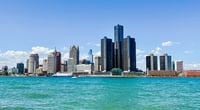
 aaoaa |
 amola |
  Tora Tora |
  yellowbutter |
  Dolly |
  US Embassy |
  NYC saladbar |
  Finding Superfoods |
  lightyear |
  song bang |
  vexomo |
  Indiana Jones |
  meloncat |
  novapixel |
  mortrix |
  Esther 1983 |
  fortbliss |
  Moscow Kim |
  My Two Way |
  toastyfox |
  FLORIDA Acus |