
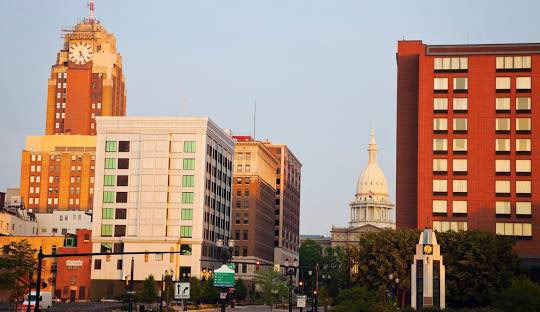
When you unfold a map of the United States, Michigan, shaped like two outstretched hands, is an iconic sight in itself. The name 'Michigan' comes from the Ojibwe language, 'mishigami,' meaning 'Great Water.' From its name, it is clear that water is an inseparable part of its identity.
Michigan's history begins with the Native Americans. This area was home to the Ojibwe, Ottawa, and Potawatomi tribes. They lived in harmony with nature, hunting, fishing, and farming in tune with the rhythms of the land, utilizing the resources of lakes and forests. The lakes and rivers of Michigan were not just waterways; they were considered the source of life and spiritual spaces.
In the early 17th century, the discovery of this region by French explorers marked a new chapter in Michigan's history. French explorer Étienne Brûlé and missionary Jacques Marquette explored the area and established trade routes. In 1701, French officer Antoine de la Mothe Cadillac founded Detroit, marking the beginning of French rule. Detroit soon grew into a center for fur trade and a military stronghold.
After the French and Indian War ended in 1763, Michigan came under British control, and following the conclusion of the American Revolutionary War in 1783, it became part of the United States through the Treaty of Paris. In 1805, the Michigan Territory was established, with Detroit designated as its first capital, and on January 26, 1837, Michigan was finally admitted as the 26th state of the United States. An interesting anecdote from this statehood process is the 'Toledo War.' At that time, there was a territorial dispute over the Toledo area between Michigan and Ohio, but Michigan instead gained the Upper Peninsula.
In the late 19th century, Michigan experienced rapid growth alongside the Industrial Revolution. Abundant resources such as iron ore, timber, and coal became the foundation of its economy, and in the 20th century, the automotive industry completely transformed Michigan's fate. In 1903, Henry Ford established the Ford Motor Company in Detroit and introduced the assembly line system, ushering in the era of mass production. Soon, GM (General Motors) and Chrysler followed, forming the 'Big Three automotive cities' centered around Detroit.
However, behind this development were waves of social change. The labor-intensive structure of the automotive industry naturally sparked labor movements, making Michigan a center for labor activism in the United States. In the 1930s and 40s, the United Auto Workers (UAW) was formed to protect workers' rights and advocate for wage increases and improved working conditions. Later, in the 1960s and 70s, issues of racial discrimination and income inequality emerged, and the 1967 Detroit riots shocked American society as a whole. Following that event, urban redevelopment and migration led to a sharp decline in Detroit's population, but recently, technology startups and artists have flocked to the city, revitalizing it once again.
Today, Michigan is not simply referred to as the 'Motor State.' It is expanding its horizons with natural resources based on the Great Lakes, clean energy industries such as wind and hydroelectric power, and advanced technology and biotechnology research. In particular, Ann Arbor has developed into a global research city in AI, healthcare, and life sciences, centered around the University of Michigan, while Grand Rapids has grown as a hub for the healthcare and design industries.
Moreover, Michigan is one of the states boasting the most beautiful natural landscapes in the United States. It borders four of the Great Lakes (Michigan, Huron, Erie, and Superior) and contains over 11,000 inland lakes. It is a year-round tourist destination, offering boating, fishing, and camping in the summer, and skiing and snow festivals in the winter. Notably, Mackinac Island is famous as a car-free island and is a representative travel destination where history and nature coexist.
Michigan was once the place that changed the world with automobiles a century ago, but now it is leading change once again with electric vehicles and eco-friendly technologies. A state where the past and future, industry and nature coexist. That is the charm of Michigan.







 tracker |
 juniper |
 amola |
 oflare |
 aaoaa |
  Anytime Journey |
  Mrs. Duluth |
  jaxter |
  Atlanta Mama |
  Baguette Blog |
  US Embassy |
  Korean Mom |
  My NYC |
  moo moo |
  Mr Oh |
  forevergee |
  festival |
  manchester |
  constant |
  Leapfrog Move |
  vibranto |
  Tora Tora |
  yellowbutter |
  Dolly |
  NYC saladbar |