

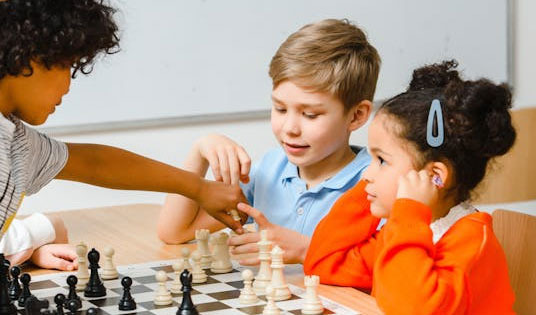
Living in Pelham Park, there are many Koreans here, and the educational issues naturally blend American and Korean styles. Recently, the topic of chess has come up in our home.
My husband, who was a member of the chess club and ranked second in school while attending university in the U.S., suggested teaching chess to our 9-year-old son.
If we were in Korea, we might have thought of Go or Omok, but honestly, I wondered, 'Isn't chess too complicated?'
However, after thinking a bit more, I realized that chess is not just a simple game but can help with brain development, which made me view it positively.
I began to expect that as my son focuses on each move, he will naturally develop his thinking skills and patience. Nowadays, children are often exposed to electronic devices like smartphones and tablets, which leaves little time for deep thinking, but I felt that chess could provide the opposite experience.
I still remember the day my husband taught our son his first chess game. As he explained pieces like pawns, knights, and bishops, my son tilted his head but showed a curious look. He asked, "Mom, this one only moves forward?" It seemed fascinating to him that even a small piece has different personalities and rules. At first, I thought he would get bored quickly, but seeing him concentrate on the board made me feel, 'Ah, this might actually suit him more than I expected.'
Learning chess is said to not only improve intelligence but also foster creativity and problem-solving skills.
Even in the same situation, various strategies emerge, and when the opponent makes an unexpected move, the process of figuring out how to respond becomes good training for the child. I really like this aspect. Life doesn't always go as planned. I hope my child learns to think flexibly in the face of change through chess.
Of course, there are points to be cautious about. Since chess is a game with clear wins and losses, the child might become too obsessed with winning or, conversely, unable to handle losing.
So, I often tell him, "It's not important who won, but what you thought is more important." I believe that having an attitude that values the process over the result from a young age will help him grow much healthier in studies and other activities.
Now, a small chessboard has taken its place in one corner of our living room. On weekends, it has become a natural scene to see my husband and son sitting across from each other playing chess.
Watching them, I feel that the time they spend together is not just about brain development but holds great significance in itself. Knowing that the time spent with parents in childhood ultimately becomes a lifelong strength for the child, I feel that chess offers our family more value than just a game.
In Korea, we often hear that playing Go develops thinking skills, but for our family living in Pelham Park, chess serves that role. Now, I find myself thinking more about 'How precious will this time be as a memory for our family?' rather than 'Will chess help my son's brain development?'



 eatontown blog |
  squidogame |
 Margarine Daebimama |
 cloudyday |
 Ishiyoung Forever 208 |
  phoenixia |
  viewtop |
  loverun |
  Kim Do Sun |
  SEVEN SEVEN |
  yentra |
  Make My Day |
  Victory 1988 |
  Tonky |
  viroma |
  cookie |
  Live and that's it |
  Alright Twain |
  HAWAII Korean Church News |
  Amore |
  linex |
  Balancework |
  laro90 |
  MEDBIO American Doctor Blog |