

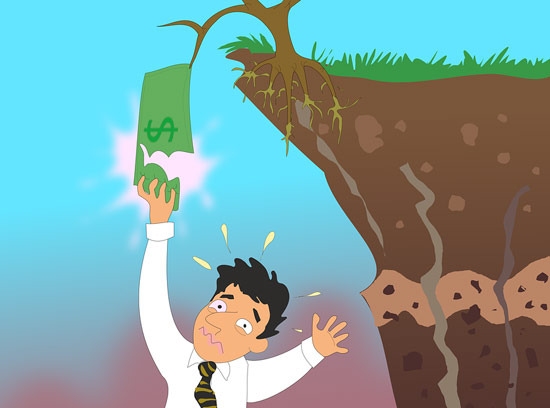
While it is said that small amounts can accumulate to a mountain, these days, looking at the investment scene, the saying that small amounts just gather small amounts seems more realistic.
Even with low returns, repeatedly making small investments or gathering all money in hopes of huge future profits, known as all-in investing, is a prime example.
Initially, one believes that even a small amount can become a large asset if accumulated, but in the actual investment environment, before small amounts can become a mountain, the market shakes first, and the weakest funds break first.
The issue is not the small amounts, but the 'all-in' approach that puts all small funds into play. The smaller the assets, the more important risk management becomes, yet paradoxically, those with fewer assets tend to have a stronger desire for a "big win."
In this structure, all-in investing becomes even riskier. Gathering as much as possible from salary, savings, and loans to invest in stocks, cryptocurrencies, and real estate can make one a hero if successful, but if it fails, years of effort can vanish.
All-in investors often make a common mistake.
First, the moment they invest funds, they ignore the 'living expense risk.' If money is tied up, there is no fund available for urgent needs. When unexpected expenses arise, such as hospital bills, moving, unemployment, or family issues, it becomes difficult to respond, leading to selling at a loss or incurring more debt. The more one prepares for risks in investing, the higher the chances of survival. No matter how good the investment product is, the moment one throws in the costs of living, it becomes more of a gamble left to luck than an investment.
Second, all-in investors underestimate the 'time risk' of the market. Even good investments require time. However, if urgent money is invested, the time to wait for appreciation disappears. For example, even if real estate prices drop, holding on can lead to a rebound eventually, but those who bought all-in cannot endure when interest rates rise or maintenance costs hit, leading to liquidation. The same goes for stocks. Although they shout long-term investment, when the moment comes that money is needed, they cannot wait and end up selling at a low point. Ultimately, it is not the market that is the problem, but the failure to manage time that causes losses. The ability to endure is the essence of investment, but all-in investing removes that endurance.
Finally, the biggest issue with all-in investing is psychology. Since they have poured in all their available money, even small price fluctuations can greatly affect their emotions. They become anxious, sell in fear, chase after rebounds, and ultimately move according to emotional trends rather than market trends. When too much capital is tied up, investment decisions are made based on 'fear' rather than 'rationality.' Stable judgment becomes impossible, and the investment profit structure is replaced by mere responses to fill gaps.
A proper investor moves to make money, but an all-in investor moves to avoid losses. The moment the perspective shifts, the game is already over. Therefore, the saying that small amounts can accumulate to a mountain is not everything in investing. Even if small amounts gather, there are principles that must be upheld.
The money used for investment should be 'surplus funds' rather than 'survival costs,' and the purpose of investing should be to create a 'structure that can endure' rather than seeking short-term profits. Before making large sums, having a strategy to avoid losing large sums is more important. For small amounts to become a mountain, time to spend and endure is necessary.
Simply pushing in money according to greed does not create a mountain; it can only accumulate when there is room to bear the risks. Ultimately, true success in investing begins not with gathering money, but with leaving the strength to endure.







 Tesla X |
 Next Year, Let's Become Rich |

 Kondae Garusong Blog |
 US Embassy |
  Korean Mom |
  My NYC |
  moo moo |
  Mr Oh |
  forevergee |
  festival |
  manchester |
  constant |
  Leapfrog Move |
  vibranto |
  Tora Tora |
  yellowbutter |
  Dolly |
  NYC saladbar |
  Finding Superfoods |
  lightyear |
  song bang |
  vexomo |
  Indiana Jones |