

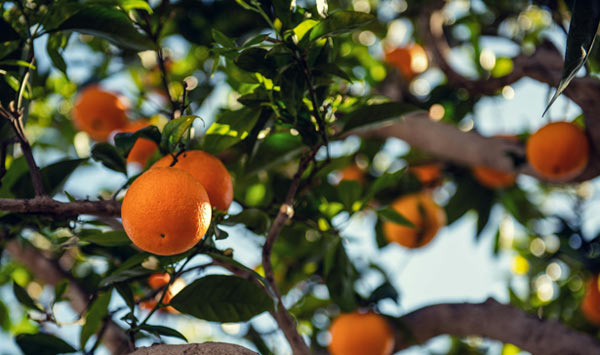
The name of Orange County in California literally comes from 'orange.' It is commonly referred to as OC.
There are about 34 cities in California's Orange County. To the north are urban areas like Anaheim, Fullerton, Buena Park, La Habra, Placentia, and Brea, while the central part includes Orange, Tustin, Santa Ana, Garden Grove, and Westminster.
Heading south, you will find Irvine, Lake Forest, Mission Viejo, Laguna Hills, Aliso Viejo, and Laguna Niguel, and along the coastline are Huntington Beach, Newport Beach, Laguna Beach, Dana Point, San Juan Capistrano, and San Clemente.
Additionally, smaller cities like Cypress, Stanton, Seal Beach, La Palma, Los Alamitos, Yorba Linda, and Villa Park make up Orange County.
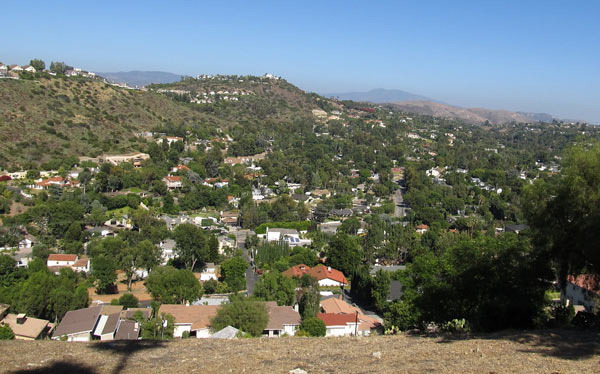
Today, well-maintained beaches, upscale homes, Disneyland, and Knott's Berry Farm come to mind, but until the late 1800s, this area was an agricultural region filled with endless orange groves. In the mid-1800s, this area was originally part of Los Angeles County, but as farmers and ranchers increased, it became independent in 1889 under the name 'Orange County.'
At that time, the main industry in the area was agriculture, particularly citrus cultivation. The Valencia orange was the primary variety, which became a symbol of California due to its ability to maintain sweetness even in summer. Navel oranges were harvested in winter, and Valencia oranges in summer, filling the air with the scent of oranges year-round. The orange groves began to flourish in the early 1900s with the expansion of the railroad network.
At that time, Southern California had mild winters, abundant sunshine, and winds from the sea that regulated humidity, making it ideal for orange cultivation. This led many settlers to flock here with dreams of the 'California Dream.' Railroad companies advertised "a land of warm winters and sweet oranges" to attract those dreaming of a new life across the United States.
The towns formed during this time include cities like Anaheim, Fullerton, Santa Ana, and Irvine. The extent of the orange groves was so vast that the area where Disneyland is located today was entirely orange groves. There is a story that when Walt Disney, the founder of Disney, visited the area in the early 1950s, it was almost all citrus farms, and he described it as "a magical land filled with sweet scents."
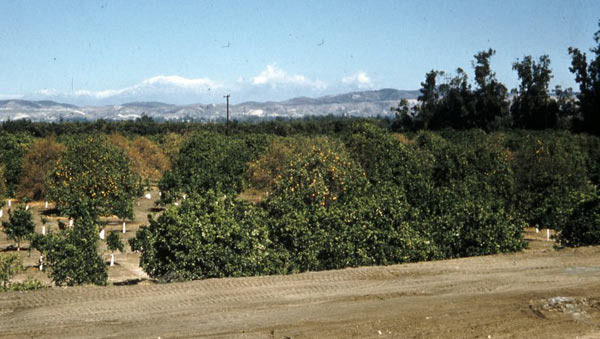
A photo of an orange farm in Orange County from the 1960s found on the internet. It was shared because there are no copyright issues.
However, by the 1950s and 60s, the situation changed. The population rapidly increased, highways opened, and agricultural land began to be converted into urban development. The places that once had orange groves turned into housing complexes, shopping malls, schools, and industrial areas, leaving only the name 'Orange County.' While it is now difficult to see the orange groves of that time, some traces still remain.
A notable place is Irvine's 'Irvine Ranch Historic Park.' This site is part of a large farm once operated by the Irvine family, where the original orange storage warehouses, workshops, and farm buildings have been restored. Another place is La Habra's 'Citrus Fair,' which celebrates Orange County's agricultural heritage with citrus exhibitions and orange juice squeezing experiences during the annual spring festival.
Additionally, some areas south of Irvine still have small orange farms. For example, places like 'Orange County Produce' or 'Tanaka Farms,' operated by the Ticoteon family, still grow and sell citrus, lemons, avocados, and strawberries directly to local residents. They are referred to as "the last farmers remaining in the middle of the city."
Recently, the concept of 'urban farming' has spread, leading some schools and communities in Orange County to attempt to maintain small citrus groves. This shows that the history of Orange County holds more symbolism than just a name.
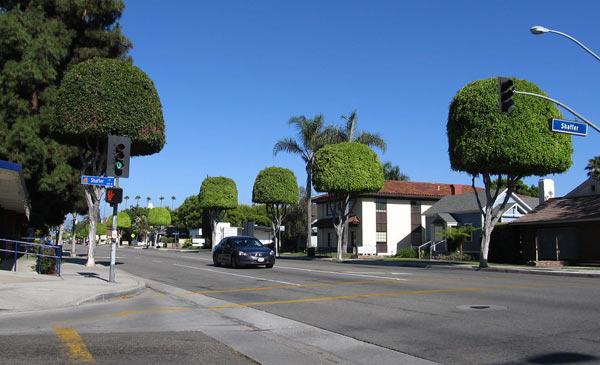
There are over 100,000 Koreans living in Orange County.
This is the second largest population after Los Angeles and forms an important part of the Korean community in Southern California. The most densely populated areas are Fullerton, La Habra, Buena Park, and Irvine, where Korean markets, churches, restaurants, and academies are concentrated.
Fullerton has had a Korean business district for a long time, where almost all necessary services such as hair salons, hospitals, banks, and law offices can be accessed by Koreans. Irvine is popular among young Korean families and students due to its good school district, while Buena Park is preferred by middle-class Korean families due to relatively stable housing prices.
Recently, Orange County faces several issues. The first is high housing and living costs. The average home price is around one million dollars, or even close to two million dollars in some areas, making it difficult for middle-class or young generations to settle down. The second is traffic congestion. The 5, 405, and 91 freeways experience severe congestion during rush hours, causing stress for residents. The third is the homeless problem. Homeless camps have increased in the Santa Ana and Anaheim areas, raising concerns about public safety. The fourth is class conflict due to rising prices and income disparity. The gap between the wealthy southern region and the relatively lower-income northern region is widening.
Until the mid-2000s, it was a livable area, but now it appears peaceful, yet internally, social balance is shaking, which is concerning. Still, I believe many immigrants and local residents will continue to thrive together.







 Pirate Ship Popcorn Maker |
 Total Beauty |
  OC Real Estate Business Information |
 Story Bank |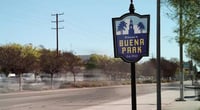
 California Information News |
  Korean Mom |
  My NYC |
  moo moo |
  Mr Oh |
  forevergee |
  festival |
  manchester |
  constant |
  Leapfrog Move |
  vibranto |
  Tora Tora |
  yellowbutter |
  Dolly |
  US Embassy |
  NYC saladbar |
  Finding Superfoods |
  lightyear |
  song bang |
  vexomo |
  Indiana Jones |