

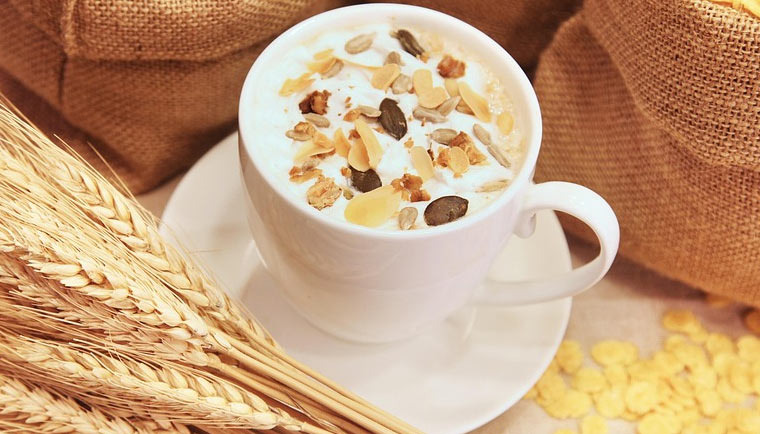
There are fascinating things the more you know. One of them is soluble fiber.
When you see cereals or health foods labeled as dietary fiber, the phrase "good for constipation" often follows.
Soluble fiber is a type of fiber that dissolves in water and is known to help with blood sugar control, lowering cholesterol levels, and improving gut health.
It is mainly found in fruits, vegetables, seaweed, and oats.
As I age and feel that my digestion is not what it used to be, I have become increasingly interested in this soluble fiber.
I learned that this water-soluble fiber does much more than just soften stools; it has a much more complex and mysterious function.
First, soluble fiber turns into a gel-like substance when it meets water. If you soak chia seeds in water, a cloudy white gel-like substance forms.
This gel-like substance slowly passes through the intestines, gently wrapping around waste and helping to prevent stools from becoming dry.
So, it is a great help for those who suffer from very hard stools.
Stools become soft like a moist sponge. Thanks to this, you don't have to engage in a 'battle of strength' in the bathroom.
But that's not all. Soluble fiber serves as 'food' for the good bacteria in the intestines.
Intestinal bacteria ferment this fiber to produce short-chain fatty acids, which play an important role in maintaining gut barrier health and reducing inflammation.
It not only helps with bowel movements but also improves the gut environment in the long term.
That's why some people refer to soluble fiber as the 'king of prebiotics.'
Another amazing point is that this fiber also affects blood sugar control.
It prevents sugars in food from being absorbed quickly, thereby alleviating spikes in blood sugar levels.
It is a great friend for those with diabetes or anyone wanting to reduce blood sugar spikes.
Additionally, there are research findings that it lowers cholesterol levels as well.
It acts like a janitor in the intestines and a protective barrier for blood vessels, making it a versatile assistant.
So, how much does it help with bowel movements?
In my experience, I started seeing effects on the third day after I began adding chia seeds, apples, and a bit of oats to my oatmeal every day.
The time spent in the bathroom was cut in half, and I felt much lighter.
However, if you eat too much right from the start, it can actually cause bloating and gas, so it's best to gradually increase the amount.
Ultimately, soluble fiber is not just a constipation solver; it is a versatile ally that protects the gut, blood vessels, and overall metabolic health.
Once you know this, you will cherish it more on your dining table.
Tonight, when you go grocery shopping, try to add a little more vegetables, fruits, and lentils or peas.
You might find comfort in the bathroom sooner than you think.







 Baguette Blog |
 Khan Film Blog Production |
 dermoon |
 hoosierdaddy |
 sun walker |
 morvex37 |

 Utah, the Most Livable State |

 Tonky |
  viroma |
  cookie |
  Live and that's it |
  Alright Twain |
  eatontown blog |
  HAWAII Korean Church News |
  Amore |
  linex |
  Balancework |
  laro90 |
  MEDBIO American Doctor Blog |
  SWAT TEAM BLK |
  DREAM BIG |
  frostbite |
  330 Forever My Love |
  El Dorado |
  dralix58 |
  Gorama Round |
  Skydiving |