
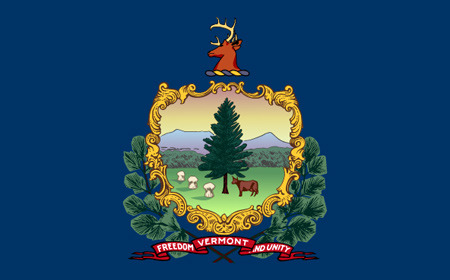
Vermont is a state located in the northeastern United States, famous for its independent history and rich natural scenery.
Early History
- The indigenous tribes, the Algonquin and Iroquois, inhabited the area and sustained themselves through hunting and agriculture.
- In 1609, French explorer Samuel de Champlain explored the area and discovered Lake Champlain.
Colonial Era
- There was a power struggle between France and Britain, and after the French and Indian War in 1763, it came under British rule.
- Local residents formed a militia called the Green Mountain Boys in opposition to New York's territorial claims.
Independence and Statehood
- In 1777, Vermont declared independence by establishing the Vermont Republic and adopted the first constitution to prohibit slavery.
- In 1791, it joined the United States as the 14th state.
Modernization and Environmental Protection
- It strongly supported the Union during the Civil War and has since maintained an economy centered on agriculture and tourism.
- Since the mid-20th century, it has upheld a clean image through policies emphasizing environmental protection and sustainability.
Population
- As of 2023, Vermont's total population is approximately 650,000, making it the second least populous state in the United States.
- The population composition is about 94% white, with small minorities of Asian, Hispanic, and African American residents.
Median Income
- As of 2022, the median household income in Vermont is approximately $73,300, similar to the national average of about $74,580.
- Key industries include tourism, agriculture, food processing, healthcare, and educational services.
Despite its small size and low population density, Vermont is regarded as a state with a unique charm in the United States due to its independent history, distinct culture, and policies that harmonize with nature.






 xelton52 |
 Joseon Dynasty Seal Enthusiasts |
 nuvex11 |
 US Embassy |
  Korean Mom |
  My NYC |
  moo moo |
  Mr Oh |
  forevergee |
  festival |
  manchester |
  constant |
  Leapfrog Move |
  vibranto |
  Tora Tora |
  yellowbutter |
  Dolly |
  NYC saladbar |
  Finding Superfoods |
  lightyear |
  song bang |
  vexomo |
  Indiana Jones |