
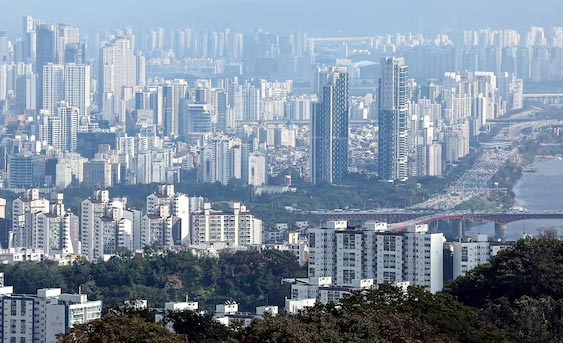
These days, the numbers in Korean news seem to be flowing in a strangely unsettling direction.
The exchange rate has risen above 1,500 won, approaching 1,520 won, and the real estate market appears quiet yet is showing signs of stirring again.
On the surface, it seems stable, but looking deeper reveals a rather tense situation.
As of early 2026, it is true that the publicly announced prices of apartments in Seoul have risen significantly.
However, this rate of increase is more a reflection of previous declines and regional re-evaluations rather than a "sharp rise in market prices."
While Seoul has seen a relatively large increase, it is also true that the rise in other regions has been limited.
Ultimately, the structure is becoming clearer: Seoul is holding strong, while the provinces are weaker.
The prices for buying and renting are closer to a gradual upward trend rather than a noticeable spike. While the numbers may not seem large, the direction is clearly upward. The gradual increase in rental prices is particularly important. In Korea, rental prices typically move first, followed by sales prices.
The key to this trend is ultimately supply. It is true that the number of new apartments in Seoul is decreasing. The impact of reduced sales a few years ago is now manifesting as a decrease in new occupancy, a typical cycle. Even when looking at the entire metropolitan area, there are ongoing discussions about a supply shortage relative to demand. However, it is more accurate to say there is a "shortage of good locations" rather than an "absolute housing shortage."
What is felt on the ground is this: there are houses available, but there is a lack of homes in desirable locations. Redevelopment and reconstruction are slow due to regulations and vested interests, and new supply continues to be delayed. Ultimately, demand is building up while supply is lagging behind.
The internal polarization in Seoul is also ongoing. However, it is more accurate to view it as differences in price ranges rather than simply saying that Gangbuk has beaten Gangnam. The ultra-high price range in Gangnam has already limited its demand, resulting in sluggish movement, while the mid to low price range continues to see real demand, leading to active transactions. Ultimately, the market is separating into "a market for those who can buy" and "a market for those who must buy."
There are also significant changes in the rental market. The shift from jeonse (lump-sum rental) to monthly rent is clearly underway. In a high-interest environment, it is more advantageous for landlords to choose monthly rent over jeonse. For tenants, the shift from a lump-sum burden to monthly cash outflow creates a much greater perceived burden. This aspect is directly linked to the economic conditions felt by the working class.
On top of this, the exchange rate variable adds complexity. An exchange rate around 1,520 won signals an increase in the external vulnerability of the Korean economy. Rising import prices and increased costs for energy and raw materials ultimately lead to higher living expenses. Monetary policy also becomes difficult to ease. This has two effects on real estate.
First, with interest rates not easily falling, the burden of loans remains.
Second, uncertainty increases across the entire asset market.
Ultimately, the current state of Korean real estate cannot simply be viewed as "rising or falling."
Thus, a "holding market" is being created, where it is difficult for the market to surge rapidly, yet it also does not easily collapse.
On the surface, it appears quiet, but pressure continues to build from within.






 |
| 
 Premium Gas Camp |
 CA Real Estate |
 cheesepup |
 breezem |
 UNI Lover |
 OC Real Estate Business Information |
 Runner Kim |
 American Food Information & Calories |
 What can make money? |
  newyorker 101 |
  coffeee |
  |
|  Christopher |
  sylven |
  Sammy Beach |
  Bliss O |
  blue ocean |
  greenlight |
  Watanaka Karametibaksa |
  castle |
  xelton52 |
  carefree |
  vrixen73 |
  AZ Road Master |
  Victory 1988 |
  summita |
  business lim |
  Colorado Lee |
  Make My Day |