
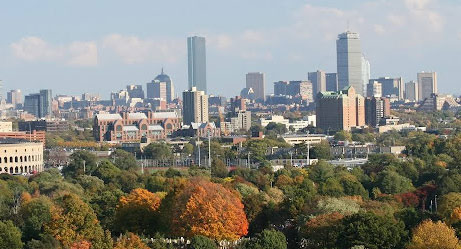
Allston is a neighborhood in Boston, serving as an important hub in the western part of the city.
It is often referred to as "Allston-Brighton" along with the neighboring area of Brighton.
Characterized by a vibrant and diverse atmosphere, it is home to many students and young people.
Historical Overview
- Early Name and Origin: Allston was originally an agricultural area belonging to Brighton until the early 19th century. It is said that the name was adopted in the 1860s and 1870s during urbanization, named after the artist Washington Allston.
- Administrative Consolidation: In 1874, Brighton was merged into Boston, making Allston part of the city. With the expansion of transportation routes like the Boston and Albany Railroad and those near the Charles River, commercial and residential development began in earnest.
- Influence of Universities: From the mid to late 20th century, parts of Boston University and Harvard University campuses were established nearby, leading to a significant influx of students and a rapid diversification of culture, music, and food.
Population
- Young Population Ratio: Allston has a high proportion of young residents compared to other areas in Boston. The presence of students and researchers from nearby universities (Boston University, Harvard, Berklee College of Music, etc.) and the service workers supporting them create a lively atmosphere.
- Approximate Size: According to official statistics (Boston city data, census, etc.), the combined population of Allston and Brighton is about 80,000. (Exact numbers may vary depending on the data point.)
- Racial and Cultural Diversity: The area is home to many international students and diverse immigrant communities, resulting in a rich racial composition. It features a mix of Korean, Chinese, Southeast Asian, Hispanic, and European immigrants.
Median Household Income
- High Proportion of Students and Renters: Allston has a notably high ratio of rental housing and student households, making it somewhat difficult to directly compare household income statistics with neighborhoods focused on typical families.
- Approximate Range: Generally lower than the overall average for Boston (median household income around $70,000 to $80,000), it is often cited in the range of $50,000 to $60,000, depending on the statistics.
- Regional Disparities: Even within Allston, there are variations in housing types and population composition between the northern area (around Harvard Avenue) and the southern area (bordering Brighton Avenue), leading to income differences in specific sub-regions.
In summary, Allston is located in the western part of Boston, where a vibrant cultural and commercial district has formed due to the influx of students and young people. Historically an agricultural area belonging to Brighton, it has developed into its current form due to urbanization, transportation network development, and the growth of nearby universities. The population is estimated to be between 20,000 and 30,000, and the median income is somewhat lower than the overall average for Boston, which can be attributed to the high proportion of students and renters. The abundance of restaurants, live music bars, cafes, and Asian and Latin American markets contributes to the charm of Allston, giving it the feel of a "small international city."
The combined population of Allston and Brighton, Massachusetts is 65,276. Allston's population is estimated to be 28,621, while Brighton's population is 43,887.
Allston and Brighton are adjacent neighborhoods in Boston, Massachusetts, and are often referred to together as "Allston–Brighton". The two neighborhoods are administered jointly and have a combined land area of 4.12 square miles.
Here are some other facts about Allston and Brighton:
History
Brighton was settled in 1630 and was part of Cambridge until 1807. Allston was annexed to Boston in 1874.
Demographics
In 2022, the most common ethnic group in Allston–Brighton was White (Non-Hispanic), followed by Asian (Non-Hispanic) and Black or African American (Non-Hispanic).
Diversity
In 2015, 29% of Allston's population was foreign born, which was about the same percentage as the city.
Age distribution
78% of Allston's residents are between the ages of 18 and 34, which is higher than the 40% of Boston's residents in that age group.






 Later Never Comes |
 Lime berry |
 Investment Information News Update |
 laro90 |
  MEDBIO American Doctor Blog |
  SWAT TEAM BLK |
  DREAM BIG |
  frostbite |
  330 Forever My Love |
  El Dorado |
  dralix58 |
  Gorama Round |
  Skydiving |
  dreamport |
  Yellow Snowman |
  Toaster Pizza Magic Show |
  velvetnom |
  Anytime Journey |
  Mrs. Duluth |
  jaxter |
  Atlanta Mama |
  Baguette Blog |
  Tan Sol |