
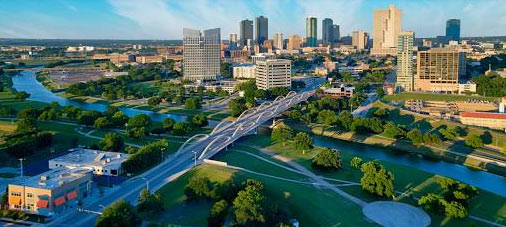
The DFW area, or Dallas-Fort Worth, is a major economic, cultural, and transportation center in Texas, with a rich historical background. This area has developed around the two cities of Dallas and Fort Worth, which have combined their distinct historical characteristics to form the current DFW region.
The Dallas-Fort Worth (DFW) area is one of the regions in Texas where the Korean community has actively formed. As of 2023, the Korean population in Texas is about 130,000, making it the third largest Korean population in the United States.
The Korean population in the DFW area is primarily concentrated in Dallas County and Denton County. According to the 2020 census, approximately 10,589 people reside in Dallas County, while about 11,094 people live in Denton County.
Additionally, the DFW area is a multicultural society where various Asian communities coexist, with the Korean community playing an important role among them. The Korean community in this area consists of diverse age groups and professions, actively engaging in various fields such as the economy, culture, and education.
History of Dallas
Dallas was founded in 1839. At that time, Texas was still an independent nation, and Dallas developed as an important trading post near the Trinity River. In 1841, Dallas was officially incorporated as a city, and after Texas was annexed by the United States, Dallas grew into a significant commercial and transportation hub.
In the late 19th century, Dallas played a crucial role as a center of railroads and transportation networks. Notably, in 1873, the connection of railroads led to a surge in commerce, prompting many people to migrate to the area. Subsequently, in the early 20th century, Dallas developed into a center for finance, insurance, and trade, establishing itself as one of the largest cities in the United States.
History of Fort Worth
Fort Worth derives its name from a military post established by the U.S. Army in 1849 to maintain peace, known as 'Fort Worth.' Originally a military base to avoid conflicts with Native American tribes, it gradually developed into a commercial center. Fort Worth is particularly known as the heart of Texas cowboy culture and is often referred to as the 'Cowtown.'
In the late 19th century, Fort Worth played a significant commercial role as an important stop for cattle drives. During this time, cowboys, merchants, and farmers gathered to engage in commercial activities, leading to significant economic growth in Fort Worth. By the early 20th century, with the expansion of railroads and transportation networks, Fort Worth prospered further, and the military and aviation industries developed, resulting in even greater economic growth.
Integration and Development of the DFW Area
Until the mid-20th century, Dallas and Fort Worth maintained their independent characteristics; however, the two cities became closely connected through interdependent economic and transportation networks. During this period, the development of highways and rail systems linked the two cities into a single metropolitan area. Notably, from the 1950s to the early 1960s, the DFW area experienced rapid population growth and urbanization.
Modern DFW Area
Today, the DFW area forms the fourth largest metropolitan area in the United States, establishing itself as a center for economy, culture, education, and transportation. This region is one of the fastest-growing cities in the U.S., with various industries thriving, particularly in technology, finance, healthcare, and logistics. Additionally, Dallas-Fort Worth International Airport is one of the largest airports in the world, playing a crucial role as a transportation and logistics hub for the area.
Ultimately, the DFW area is a representative example of how the historical backgrounds and developments of the two cities intertwine, growing into a central economic and cultural hub of Texas.




 xylora |
 Aura-Infused WACAM |
 wendra |

 There Are Such Things in the World |
  Korean Mom |
  My NYC |
  moo moo |
  Mr Oh |
  forevergee |
  festival |
  manchester |
  constant |
  Leapfrog Move |
  vibranto |
  Tora Tora |
  yellowbutter |
  Dolly |
  US Embassy |
  NYC saladbar |
  Finding Superfoods |
  lightyear |
  song bang |
  vexomo |
  Indiana Jones |