
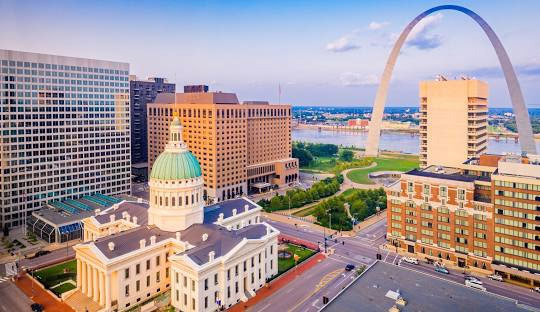
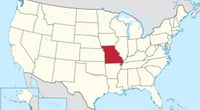
Missouri is a state located in the Midwestern United States, rich in historical and cultural background. Missouri played a significant role in early exploration and settlement, westward expansion, and political conflicts within the United States, establishing itself as a state through various historical events and developments.
Early History and Settlement
The Missouri region was originally home to Native American tribes such as the Osage, Missouri, and Quapaw. They utilized rivers and forests for agriculture, hunting, and trade. In 1673, French explorers Jacques Marquette and Louis Jolliet were the first to introduce this area to Europeans, after which France and Spain alternately governed the region.
In 1803, the United States incorporated Missouri into its territory by purchasing a vast land from France through the Louisiana Purchase. In 1812, the Missouri Territory was established, marking the beginning of a significant influx of settlers.
Statehood and the Missouri Compromise
Missouri joined the Union as the 24th state on August 10, 1821. However, the process of Missouri's statehood is associated with a significant political event known as the "Missouri Compromise."
At that time, the United States was facing escalating conflicts between the North and South over the issue of slavery. When Missouri applied for statehood as a slave state, concerns arose about disrupting the balance between slave and free states. To resolve this, the Missouri Compromise, led by Henry Clay, was established in 1820.
- Missouri joined the Union as a slave state,
- while Maine joined as a free state, maintaining the ratio of slave to free states at 12:12.
Additionally, slavery was prohibited north of the 36°30' parallel in Missouri. This compromise temporarily eased tensions between the North and South but laid the groundwork for greater divisions related to slavery.
Westward Expansion and Transportation Hub
Missouri played a crucial role during the westward expansion era, often referred to as the "Gateway to the West." In particular, the Missouri River and the Mississippi River served as major conduits for trade and movement, boosting the regional economy.
- St. Louis was the starting point for settlers heading west, especially as the important junction for the Oregon Trail and the California Trail.
- Moreover, the eastern terminus of the Pony Express, which began in 1860, was located in St. Joseph, Missouri.
The Civil War and Aftermath
Missouri was strategically important during the Civil War, facing complex political situations as a border state between the Southern slave states and Northern free states.
- Missouri officially remained with the Union (North), but many residents were Southern sympathizers, leading to numerous battles and conflicts within the region.
- A notable battle was the Battle of Wilson's Creek in 1861, recorded as one of the significant events in the Missouri War.
After the war, Missouri underwent rapid industrialization and urbanization. St. Louis and Kansas City grew as important industrial and transportation hubs, and agriculture and trade continued to develop.







 roma |
 calviro |
 Kansas City Representative Singer |
 calvix |
 Iri Jori Missouri |
  laro90 |
  MEDBIO American Doctor Blog |
  SWAT TEAM BLK |
  DREAM BIG |
  frostbite |
  330 Forever My Love |
  El Dorado |
  dralix58 |
  Gorama Round |
  Skydiving |
  dreamport |
  Yellow Snowman |
  Toaster Pizza Magic Show |
  velvetnom |
  Anytime Journey |
  Mrs. Duluth |
  jaxter |
  Atlanta Mama |
  Baguette Blog |
  Tan Sol |