

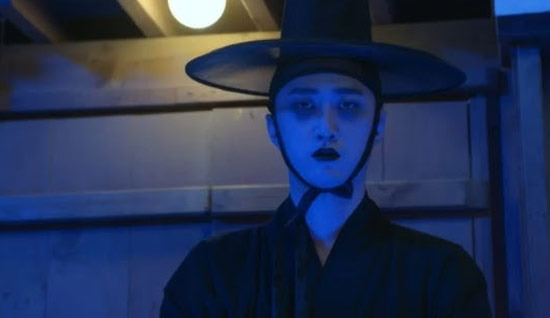
The image of the 'grim reaper in a black hat and black robe with a pale face' that we think of today did not naturally come from an ancient tradition. Rather, it is a product of the relatively recent television era of the 1970s and 80s.
The classic horror drama 〈Legend of the Homeland〉, which aired weekly on KBS 2TV, originally started on KBS 1TV and moved to 2TV around September 1981. It was Korea's first thriller drama and is considered the origin of summer horror specials, having had a significant influence.
In particular, the image of the 'ghost with long hair in a white funeral dress' that the public thinks of today was established through this work, and this style became the horror code in subsequent films and dramas. Additionally, the grim reaper with a pale face, black robe, and black hat is said to have originated from the idea of the director Choi Sang-sik. Ultimately, the foundation of Korean ghost fashion began not from tradition but from a broadcasting station.
Director Choi Sang-sik, who directed Legend of the Homeland, later appeared on a variety show and shared how the grim reaper image was created. He stated, "I wanted to express the image of death in a Korean way." After much thought, the concept he came up with was 'pitch-black death.' He painted the hat black, the robe black, and the face white to create contrast, adding a strong black point to the lips.
This was a direction aimed at visually maximizing the eerie and unrealistic atmosphere of death. The design first appeared in the episode 'My Soul, Another's Body' aired on June 3, 1980. The image that debuted at that time became the standard for the grim reaper in popular culture, continuing into films, webtoons, and dramas.
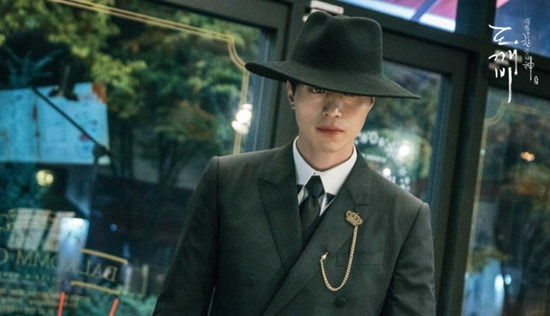
The grim reaper in the drama Goblin was depicted as a new style of reaper, standing out with minimal fashion and an emotionally restrained personality, unlike the existing scary image.
Instead of a black robe, he wore a modern black coat, and instead of a hat, he had a fedora or neat hairstyle, characterized by a calm tone that did not easily reveal emotions. In particular, his attitude of "It is the sinner who dies, and I merely take them" shows that the grim reaper is not a being that forces death but rather a public servant guiding souls according to a set procedure.
Seeing that the grim reaper has juniors and seniors, it can be viewed as a modern reinterpretation. Although he appears cold on the outside, the setting that he is a character punished by oblivion for forgetting his past sins makes the grim reaper a multidimensional being with a 'drama of guilt and salvation' rather than just a simple horror character.
Thanks to this modern reinterpretation, the grim reaper has established himself as a character that is not scary but mysterious and attractive, becoming a new icon of the Korean reaper that has influenced other works.
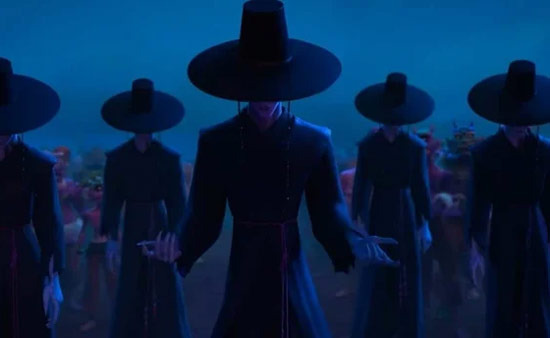
In the K-pop Demon Hunters universe, the grim reaper appears as a reaper with idol-style visuals and concepts.
He possesses a modern black coat and transcendent power, and with emotional connections to humans, he performs a heroic role not just in taking souls but in hunting evil spirits and maintaining balance.
On stage, he symbolizes death and salvation with captivating performances, while in the narrative, he showcases emotional stories of teamwork, conflict, atonement, and choice, presenting a new 'character-type reaper' to the fandom.
However, the image of the grim reaper in black clothing is not entirely a result of modern creation.
Traces of it can also be found in past funeral cultures. In the 19th and 20th centuries, folk funeral processions often featured wooden dolls called 'gokdu' placed on or around the coffin. Some of these dolls were depicted in black clothing, resembling the modern grim reaper.
It is difficult to view Legend of the Homeland as a character completely newly created; rather, it can be seen as a result of modernizing a character drawn from long-standing folk images.
Ultimately, the image of the grim reaper that we know today is a creation that began from a 'complex cultural content' formed by the combination of traces of old funeral culture and 1980s television direction. Interestingly, in folk beliefs, the grim reaper is a character that has human-like qualities, makes mistakes, and sometimes accepts bribes, yet his appearance has solidified into a rigid 'face of death.'
Thus, the reason why the grim reapers in today's Korean dramas appear in stylish black coats actually stems from the aesthetic concerns of horror drama directors.







 HAWAII Korean Church News |
 Gorama Round |
 LIZ Legal Information Blog |
 Egg Steamed Pot |
 novapixel |
 humpday sonata |
 Piano Teacher Blog |
 Kkikki Ppappa Shout Out Loud |
 U.S. Weather Bureau News |
 American Airlines Mileage |
  Tonky |
  viroma |
  cookie |
  Live and that's it |
  Alright Twain |
  eatontown blog |
  Amore |
  linex |
  Balancework |
  laro90 |
  MEDBIO American Doctor Blog |
  SWAT TEAM BLK |
  DREAM BIG |
  frostbite |
  330 Forever My Love |
  El Dorado |
  dralix58 |
  Skydiving |